There is a widespread adoption that a low FODMAP diet might be the perfect solution for fructose malabsorption (FM), which is also called Dietary Fructose Intolerance. It actually improves the symptoms and people are experiencing relief through it.
However, there is a better, less-restrictive diet for fructose malabsorption. You will see in the following, why a low FODMAP diet is actually more of an “overkill” and what I prefer instead.
But before I go into detail, let’s start with some basic explanation of what FODMAPs are and what the original use of a low FODMAP diet was.

Table of Contents
What are FODMAPs and which are critical in the case of fructose malabsorption?
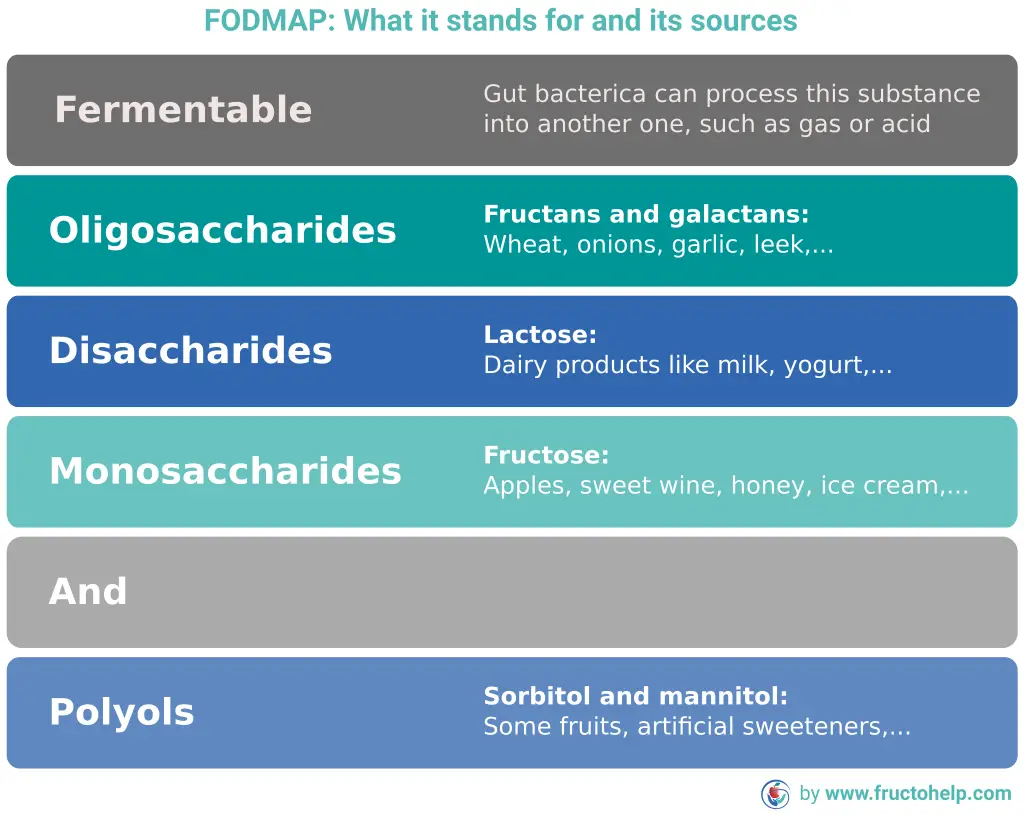
The term FODMAP stands for “Fermentable Oligosaccharides, Disaccharides, Monosaccharides, And Polyols”, which are poorly absorbable short-chain carbohydrates (sugars). Bacteria in the intestine can ferment these carbohydrates into other substances, such as gases and acid, which may cause symptoms, like diarrhea, pain, and flatulence.
Oligosaccharides are carbohydrates such as galactans (GOS) and fructans, which consist of a small number (>2) of monosaccharides. Fructans should be avoided in the case of fructose malabsorption and can be found in vegetables like leek and onion. Galactans, however, may be fine for many people with FM.
Disaccharides are sugar molecules consisting of just two monosaccharides. A fermentable example is lactose. It can be found in dairy products and is no problem when having only fructose malabsorption.
Monosaccharides mean the simplest forms of sugar. In the case of FODMAP, it refers to fructose, our main foe.
Polysaccharides are long chains of simple carbohydrates (>10), also called sugar alcohols. Fermentable are sorbitol and mannitol. They can be found in some fruits, such as peaches and cherries, and are typically used as artificial sweeteners. Polyols worsen the symptoms of fructose malabsorption due to their laxative effect. If you are interested in sweeteners for FM, you can read more about them in this article.
The prime use of a low FODMAP diet
Since its introduction in 2004 by the Monash group, the low FODMAP diet has been used as the first line of dietary therapy for patients with irritable bowel syndrome (IBS). Irritable bowel syndrome stands for the occurrence of multiple symptoms, including abdominal pain, diarrhea, bloating, and changes in the bowel movements.
Although the diagnosis IBS shouldn’t be made before excluding all other digestive diseases and intolerances, it is often used inflationary. That’s also why the low FODMAP diet is a huge business by now, and I recommend critically questioning the diagnosis IBS when no H2 breath test or proper intolerance diagnostic has been made.
What is less known about the origin of the low FODMAP diet
The low FODMAP diet actually evolved from a “Fructose Malabsorption” diet, which was developed in the 1990s and early 2000s [1]. This diet was basically like the one I explain and recommend here. Avoiding high-fructose food, fructan-containing food like onions, and artificial sweeteners like sorbitol were its main pillars. Basically, it was a “FOMAP” diet with lactose-containing food and with fructans being the only forbidden oligosaccharide.
So, yes or no to a low FODMAP diet for fructose malabsorption?
There exist a myriad of apps, guides, websites, books, online courses, and even certified low FODMAP food, which makes a low FODMAP diet convenient to use as a dietary therapy for fructose malabsorption. And it will show results in most cases. That’s the positive aspect of that combination.
On the other side, it also restricts your food intake more than necessary. Galactans may be tolerable in your case and lactose-containing dairy foods shouldn’t be a problem at all when having only fructose malabsorption. Unfortunately, there exist way fewer resources for a pure fructose malabsorption diet. That’s the reason, why I have made this website.
So, it finally depends on you. If you want to use a low FODMAP diet for dealing with fructose malabsorption and can live with a more restrictive diet, feel free to do so. I’ve compiled a list of some of the most useful low FODMAP diet charts, food lists, guides, and books for you.
But, if you want to enjoy every food, that is still possible with fructose malabsorption, I recommend going with an FM specific diet and experiment with it. Not every food, that is marked as “forbidden” may be a problem for you. Everyone is different. In case you want to go that way, check out my Fructose Malabsorption Food List. You will find a searchable food table, a link to a useful nutrition guide, and a comprehensive infographic on this page.
One last note: Whatever your final decision might be, please also consult a medical doctor or a registered dietician before starting such a strict diet.
I hope I could help and wish you a life without nasty FM symptoms!
References
- Peter R. Gibson. History of the low FODMAP diet, Journal of Gastroenterology and Hepatology 2017; 32: 5–7.